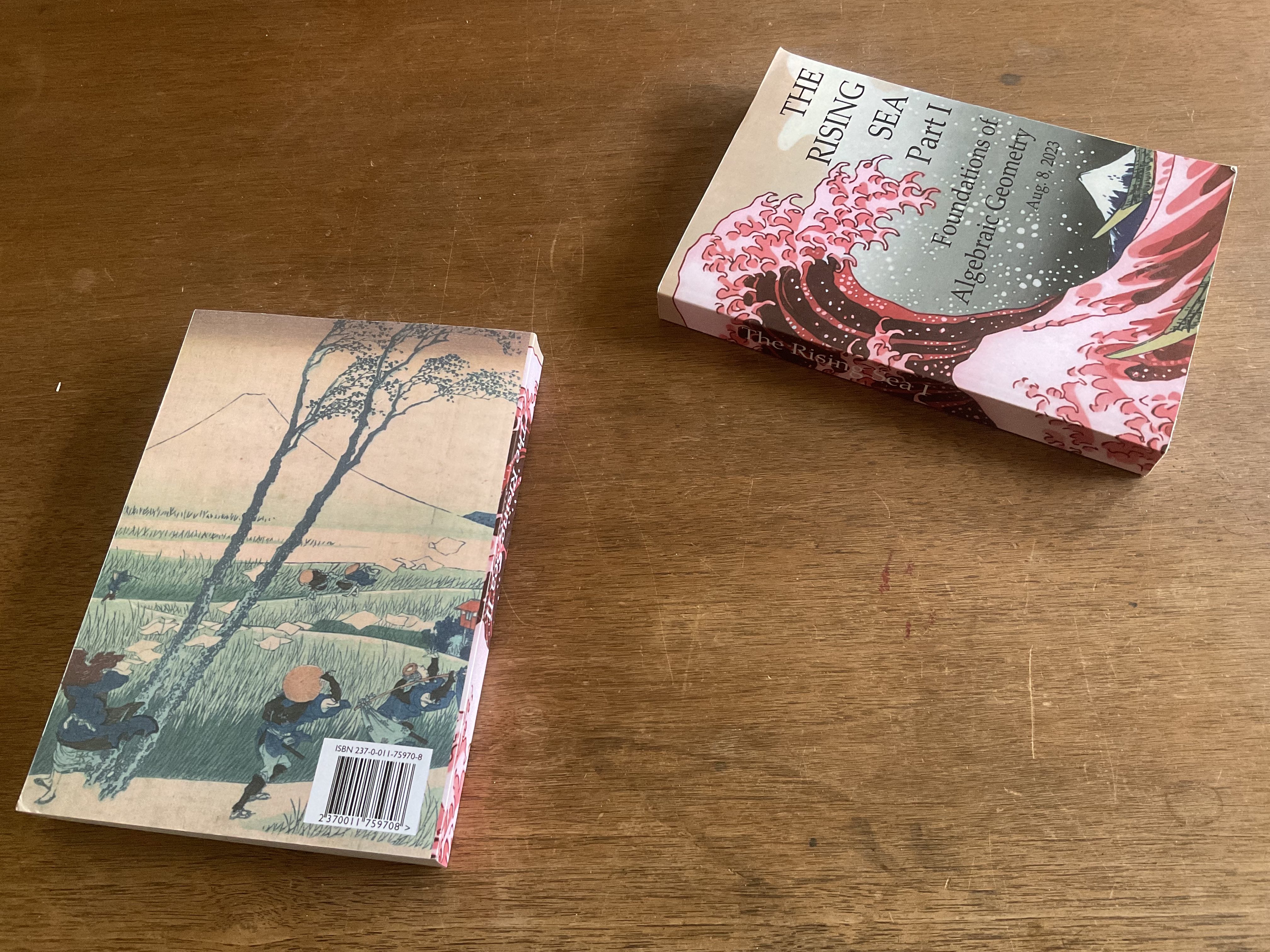
The course webpage is here (http://tinyurl.com/FOAG1112). The course notes are here.

A revised version is now posted at the usual place. The first quarter of our academic year is now over (meaning I’ve completed the first third of the course), so now is a good time to report how things went.

First, I’ll briefly explain changes since the last version (which was posted without much fanfare late in the quarter). (i) The long-promised starred section on geometrically connected (and irreducible and reduced and integral) is now added (10.5); if anyone tries any of it, please let me know how it goes. (ii) The section on (very) ample line bundles was pulled out of 16.3 (on globally generated and base-point-free line bundles) into a new section (17.6) because Giuliano Gagliardi pointed out that it used pullbacks Important Theorem 17.4.1 (describing maps to projective schemes in terms of line bundles — also known as the functorial description of projective space). Odds are unfortunately high that I’ve screwed up some dependencies, so if you find yourself in that part of the notes, please keep an eye out for unintended consequences. (iii) I’ve finally changed (open, closed, locally closed) “immersion” to (open, closed, locally closed) “embedding” throughout (the horror!).

Now back to a report on the class. I was pleased with how it went — we covered more than I’d hoped, reaching 12.2. This is far more than a third of the notes, even taking into account the chapters and sections that are not yet fully written. I should admit that the class was unusually strong this year, and thus not representative, but my hypothesis that one can cover a huge amount of the foundations of the subject in a single-year course looks like it might be vindicated. There were fewer comments in class than usual (has the exposition solidified too much?), but the problem set solutions were very strong. Partially by design, we ended with a “punchline” (a pleasant concluding topic that I think courses should ideally have — even if it is often not possible): I spent much of the final lecture discussing lines on surfaces in 3-space. Given what we know, we were able to prove interesting things, and also get a glimpse of geometrically interesting ideas in the future. I hope this helped give some relief from the intense barrage of formalism leading up to it.

I have two possible punchlines in mind for the second (winter) quarter: the theory of curves, or intersection theory. And while it is dangerous to predict two quarters in advance, one possible punchline for the final (spring) quarter is the topic of the 27 lines on “the” cubic surface.

Comments, suggestions, and corrections many of you have sent in (by commenting here, or by emailing me) have been very helpful. I am behind on responding to them, but I’m notably less behind than I was at the start of the quarter, and I expect this to continue. So please keep sending in comments (even highly opinionated ones)!

A revised version of the notes is now posted in the usual place.

I am continually learning more about how rich and complex the notion of associated points is. I had first understood them in terms of primary decomposition. My initial presentation was quite algebraic, and geometrically unmotivated. I later realized that associated points could be better understood without primary ideals, and the result would be streamlined and shorter. The result was in the version originally posted on this site (and that remained in the notes until the new version). I was pleased with myself: people could get through associated points without too much sweat, although without much motivation. (Feedback from readers and students confirmed this: people found this section more obscure than I would have liked.)

Just over a year ago, Matthew Emerton vigorously argued in this comment that there was a much better geometric point of view. My experience in the past is that when Matt makes a point like this, it causes a revolution in how I think about the topic, and indeed it happened again. (Charles Staats joined the discussion as well.)

As I’m about to discuss associated points in this year’s course, I’ve had a chance to carefully think over Matt’s point of view. I’m not surprised that he convinced me; but I am surprised at how big a difference his perspective made to me. (I also find striking that this is my third point of view on associated points, and I can even see a case for a fourth or a fifth depending on how you think. As one example, primary ideals are certainly absolutely central from many points of view.)

Section 6.5 now attempts to get across this perspective, and I offer it somewhat tentatively, because I may be missing some insights that will make it cleaner still.

Here is the current exposition. As always, the most important things for a reader/learner/expert to know are properties of a concept, not the definitions or proofs. I state the key properties first; they are quite different than the key properties I had in the previous incarnation. As I now see it, the key properties are this. Let A be a Noetherian ring (for now), and M a finitely generated A-module.

Following (my interpretation of) Matt’s inspiration: the most important property is:

(A) The associated points of M are precisely the generic points of irreducible components of the supports of sections of \tilde{M} (elements of M).

This leads to lots of useful properties by purely geometric thinking (as Matt points out). We could even take it as the definition, but in the rigorous development, I don’t. (Side point: a variant of this is the statement that the associated points of M are precisely the generic points of supports that happen to be irreducible. I found this less useful, but perhaps I’m missing some insights. It’s possible Matt had this definition in mind.)

There are two other “first principles” to keep in mind.

(B) There are a finite number of associated points.

(C) A function is a zero-divisor if and only if it vanishes at an associated point.

I couldn’t get (B) and (C) to follow cheaply from (A). But lots of great properties follow from these (especially (A), sometimes with the help of (B)), including:

  1. Generic points of irreducible components are associated.
  2. The map from M to the product of stalks/localizations at the associated points is injective.
  3. The support of m \in M is the closure of those associated points where it is supported.
  4. The nonreduced locus of Spec A is the closure of the nonreduced associated points.
  5. The notion of associated points behaves well with respect to localization, so for example we can define associated points of (coherent sheaves on) locally Noetherian schemes.

In order to establish (A)-(C), I need some algebra, which I do in a series of exercises. I’m not surprised that algebra is necessary, because Noetherianness (of the “sheaf”, not just the topology) needs to be used. But perhaps the exposition can be “geometrized” further, to make it more geometrically natural. (Any suggestions would be appreciated — not just for the notes, but for me!)

In particular, the definition of associated prime I take is a prime that is the annihilator of some element of M. I show (B) and (C) directly, as well as #2 and #5, which I then use to show (A).

Any comments on the exposition would be greatly appreciated. Am I missing some fundamental insights that would simplify things? Is the exposition readable to someone seeing it for the first time? Are the problems gettable by people seeing these ideas for the first time? I’ll get some feedback from my class, but they are not representative of a possible readership (as many of them know a ridiculous amount).

(I’m curious how much of this carries over out of the Noetherian or integral setting. If the various definitions then differ, which is the “right” one? But this is a secondary issue; I haven’t thought about it much, and it also is less relevant for most learners.)

A revised version is now posted at the usual place. There are no new sections. I’ll be posting revisions over the next academic year, in response to comments from the course, comments here (both new and old), and a large number of emails I’m gradually going through.

I won’t bother adding a new post in the future when there are only relatively minor revisions. But if you want to be informed, just let me know. And if people would prefer that I announce each revision, I’ll do so.

The eighteenth version of the notes is the September 6 version in the usual place. The most important advance since the seventeenth version are a number of changes in response to many suggestions from various people (most recently some insightful ones from Jakub Byszewski). A chapter on the 27 lines is also added — more on this below. There will a pause in the posts for this reason:

Benjamin holding Jacob

I owe responses to a number of recent comments and emails.

Here is where the project currently stands. The year-long plan of putting most of the notes online is now declared complete, and is more complete than I’d hoped at the start. (Only) three substantive topics (chapters) remain to be added: smooth/etale/unramified; regular sequences; and formal functions (and related topics: Zariski’s main theorem, Stein factorization, etc.). A reasonable amount of topics need substantial editing in response to comments, and there are some small topics I still want to add. Other things will be added much later, including a proper introduction, bibliography, and index.

This academic year, I will teach a three-quarter graduate class based on these notes, so my focus will shift to where in the notes the class is. I will test my assertion that the important parts of this material can be covered in a year-long class that will be considered a success by a reasonable number of those students who last until the end, and that a reasonable number of students will last until the end. (I also want the course to be considered a success by students who choose to take only the first quarter, or the first two. It should be considered worthwhile — even if hard work — for students not intending to become hard-core algebraic geometers, and there should be a nontrivial number of these.) The webpage for the class will be on this “blog”, and I will welcome emails and comments from people whether or not they are enrolled in the class.

Advice sought.

In a course like this, it is essential that students solve a large number of problems, and get feedback on them. Unfortunately, we don’t have the resources for a grader, so I’m trying to think of some creative alternative. In quarters two and three of previous incarnations of this course, I’ve had people hand in problem sets, and have kept track of what problems people did, and read some of their solutions. It was far from ideal, but was better than nothing. This will be tricky for me, especially at the start of quarter one, as there will be more students (and I need to quickly convince those without sufficient background to take other classes instead), and the baby will be very small (and time and attention and sleep will be in short supply). One possible alternative is to require enrolled students to read and grade each others’ homework — say they have one week, during which they have to grade three of the problems that I pick. Students would hand in homework to me electronically (e.g. scanned, if their solutions were handwritten). I would glance at the solutions, keep track of who did what, pick the problems in each set to be graded, and then divide up the submissions among the enrolled students (so even unenroled students would get feedback), and give them a week. This would be a bit slow and cumbersome. Could this work? Has anyone tried this, or anything else (besides just letting students work on their own with no feedback — something which is standard, but which I think is far from ideal)?

Random questions

I’ve redone Chevalley and related things, including the proof that codimension is the difference of dimension for varieties. Any comments on this (or anything else) would be appreciated.

There is currently no definition of generically finite in the notes. This is because it isn’t clear to me what the accepted definition is, even though this phrase is tossed around in talks. I was pleased to recently find out that Johan de Jong was in a similar position; the section of “generically finite morphisms” in the stacks project had some theorems, but no definitions. We had a discussion on what the definition is, and the result is here. What do you think of these two definitions? Or is there some official definition in the literature?

I remain confused on the right definition of Hilbert function. It is one of two things. (i) If M is a finitely generated module over a graded ring, it can be the dimension of the various graded pieces. Special case: the graded ring of a projective variety. (ii) If X is a projective variety (with embedding into projective space), it can be the dimension of the restriction of degree n polynomials (in the projective coordinates) to X. I want to use (i), but fear that (ii) may be right, at least for some people. (The definitions disagree: consider 3 distinct points on a line, where the value of the first polynomial is 3, and the value of the second polynomial is 2.) Can anyone give an opinion, informed or otherwise? (This was discussed earlier here.)

The twenty-seven lines

I’ve thought through the 27 lines, and have tentatively decided that this is a worthwhile fun chapter to have near the end of the notes. I am tentatively hoping to end the 2011-12 course with this topic. It is beautiful, and also connects a number of ideas and themes. (On the other hand, I’m trying to hew to a tough line about what gets included, so I’m seriously considering removing it again.) As usual, comments would be very appreciated — if you’ve always wanted to learn why there are 27 lines on every cubic surface (not every standard source has a complete proof, although this sometimes is not clear), and want something readable, please take a look (and when you find it isn’t readable, complain). There are a few references to the chapters not yet public (Castelnuovo’s criterion; miracle flatness); please excuse them, and take them as black boxes.

After thinking this through, I’ve had some thoughts on this question, which I may as well record here. There are a number of different possible results one can prove. (a) One can show that every smooth cubic (over an algebraically closed field) has precisely 27 lines. (b) One can show that \mathbb{P}^2 blown up at six points (in suitably general position) can be anticanonically embedded as a cubic surface, and such surfaces have precisely 27 lines. (c) One can show that every smooth cubic is a blow-up of \mathbb{P}^2, and hence use (b) to prove (a). Different people do different things. It is possible to prove (a) rather quickly and in a low-tech manner. (Miles Reid’s Undergraduate Algebraic Geometry does a great job of this. I am a Miles Reid fan in general.) One can show (b) relative quickly, although the “embedding” part can be a bit annoying. (Hartshorne follows this route.) With Castelnuovo’s criterion (which requires formal functions), one can show (c) (and hence (b) and (a)); to get this going, you need two skew lines in the cubic surface, and precisely five lines in the surface meeting them both.

I decided to do something slightly longer, and prove (a) first, by showing the key result that the space of lines in a fixed smooth cubic surface is reduced of dimension 0. I find this enlightening for a number of reasons I won’t spell out here, even though it comes down to an explicit calculation. I’d be interested to hear what opinions people have on this; I may be convinced to save some space, and just directly find the two skew lines and five lines connecting them.

The seventeenth version of the notes is the July 21 version in the usual place. This version has a complete exposition (i.e. everything I currently intend to say) of flatness (chapter 25), and a proof of Serre duality (chapter 28). Some content is added earlier (e.g. the Artin-Rees Lemma). The next post may appear in August, depending on baby constraints.

FlatnessIsGod

Status report.

There are only three more content chapters still to come, one on smooth/etale/unramified morphisms; one on formal functions and related issues (Zariski’s main theorem, Stein factorization, etc.); and one on regular sequences and related issues (local complete intersections, Cohen-Macaulayness, etc.). I’m 100% sure they will appear, but I’m not sure when (again, due to oncoming family constraints). Of course, a lot of work remains to be done to fill in holes and patch problems in the rest of the notes (and responding to old comments), so I may spend some time doing that.

I also want to take this opportunity to thank Sándor Kovács for advice throughout this project (and before), both technical and otherwise.

For learners.

Flatness is confusing the first time you see it. Also the second and the third. But with each iteration, you will digest and master more aspects of flatness. With most parts of algebraic geometry, when you learn a concept, you get used to one strange thing and then you’re good to go. That’s not true with flatness — when thinking over this chapter, I realized that there are many different types of results and arguments that come up. I’ve done my best to organize them, and to discuss no more than I find brutally necessary. (Many important flatness facts are left unproved or unstated, but hopefully by the end you will know enough to be able to read what you need elsewhere.)

The structure of the chapter is described in 25.1.1, so I won’t repeat it here.

I hope some of you read the proof of cohomology and base change — if you do, please let me know, and please let me know what is most confusing!

Here as always are some suggested problems. Of course, try every exercise marked “easy”. If it isn’t easy, let me know!

Here are twelve problems on flatness: 25.2.E (transitivity of flatnes); 25.2.G (relating flatness in algebra with flatness in scheme theory); 25.2.L (explicit examples), 25.2.M (cohomology commutes with flat base change — this looks hard but isn’t), 25.3.A (explicit and important Tor calculation), 25.3.F (practice with Tor), 25.4.D (flat = torsion-free for a PID), 25.4.F (“finite flat morphisms have locally constant degree”), 25.4.I (an explicit example that will come up later, involving two planes meet at a point), 25.5.D (going-down for flat morphisms), 25.5.F (fibers of flat morphisms have the “expected dimension”), 25.7.B (important! invariance of many important numbers in flat families), some 25.8.A-F (using cohomology and base change),

If you want to work through some pleasant explicit examples, I’d recommend 25.4.8 onwards, on flat limits. Another fun discussion that will help you see if you understand flatness well enough to do something is Hironaka’s example of a proper nonprojective nonsingular threefold, 25.8.6. If you get stuck, please let me know.

If you read 25.10 on flatness and completions, please let me know how it went.

Chapter 28 is a starred proof of Serre duality. I hope some of you try to read it — it is not double-starred, which means that I intend for this to be readable, and not just an indication that a proof exists. As with flatness, I try to prove no more than I really need to given this stage of the notes/course. If you read this, some good problems to try are 28.3.C (relations among Ext, sheaf Ext, and H^i), 28.3.H (Ext and vector bundles), and 28.3.J (the local-to-global spectral sequence for Ext).

For experts (and general discussion)

The Artin-Rees Lemma.

Greg Brumfiel explained the Artin-Rees Lemma to me in a way that made it very natural — enough so that I can no longer forget the proof. I’d never understood it well before. I hope I’ve gotten it across with some semblance of Greg’s clarity (13.6 and parts of 25.10).

Question: suppose A is a Noetherian ring, and I an ideal. Suppose 0 \rightarrow M \rightarrow N \rightarrow P \rightarrow 0 is an exact sequence of A-modules. I find it entertaining that it remains exact when tensoring by \hat{A}, but that 0 \rightarrow \hat{M} \rightarrow \hat{N} \rightarrow \hat{P} \rightarrow 0 need not be exact (without coherence hypotheses on the modules — perhaps just on P?). Does anyone have a( reference to a)n example where exactness does not hold? (And as a consequence, we’ll see an example where completion is not the same as tensoring with \hat{A}.) Update August 17, 2011: An answer is given in the section “Completion is not exact” in the “Examples” chapter of the Stacks Project. I’m not sure how to find out the tag. But I’ll add this example, in the version to be released around the end of August.

Flatness.

I found the flatness notes of Brian Lehmann (available on his webpage) very nice. Andrew Critch’s enlightening a postiori explanation of how to think about flatness is incorporated into
Remark 25.4.2, just before the equational criterion. (Side remark: we don’t use the equational criterion for anything.)

I hope someone looks closely at my exposition (and proof) of Cohomology and Base Change. That’s a topic where I think I learned the right perspective only by talking to people, and part of my goal is to translate some of the folklore into writing. If you have never bothered fully understanding the proof, and want to, please take a look and let me know where the exposition confuses you. (It is now divided up into some general facts about cohomology of complexes, and a very short argument for the theorem itself.)

Max Lieblich told me that he first figured out Cohomology and Base Change by translating to local rings, and working there, which has the advantange that you can make short exact sequences split. I could imagine that this would yield an even faster exposition. (One worry: the statement I want of cohomology and base change involves an honest Zariski open set, see part (i) of my statement. But I bet Max’s approach would give that too.) Partially because I’d already written this, I haven’t tried to piece together how Max’s argument should go. But if someone does, or someone thinks I should because it would make things more transparent, please let me know.

The flatness chapter is disappointingly long — and I even didn’t prove (for example) that the flat locus is open (under reasonable hypotheses). I didn’t prove Grothendieck’s generic freeness lemma because I didn’t use it (but I stated it). I didn’t prove the fibral flatness theorem, but stated it. Are there things that I really should include? Are there things I’ve included that you think could reasonably be tossed in a first course? (You’ll noticed that lots of the chapter is already starred or double-starred.) One fact that isn’t there but will be (in a later chapter) is what Brian Conrad calls “miracle flatness”, about a morphism \pi: X \rightarrow Y to a nonsingular scheme, and relating the flatness of \pi, the equidimensionality of the fibers, and the Cohen-Macaulayness of X.

Serre duality

I’m going to upset some people here, by not proving the “right” statement. My goal, given that this discussion comes at the end of a long set of notes, and at the end of a long course, is to prove just enough to justify the statements made earlier in the notes.

Here’s what gets used:
(i) we need a perfect pairing (28.1.1.1) H^i(X, \mathcal{F}) \times H^{n-i}(X, \mathcal{F}^{\vee} \otimes \omega_x) \rightarrow k in good circumstances.
(ii) We need the dualizing sheaf to be the determinant of the cotangent bundle if X is smooth.
(iii) Perfect pairing (i) often arises from something better (which I call Strong Serre duality) which is an isomorphism \rm{Ext}^i_X(\mathcal{F}, \omega_X) \rightarrow H^{n-i}(X, \mathcal{F})^{\vee}.
I show (iii), but don’t show that these maps are well-behaved in any way at all — for what we do, we don’t need the perfect pairing (28.1.1.1) to be “natural” in any way — we just need dimensions. The reason I can’t show any sort of naturality (in a pedagogically easy way) is that it isn’t worth the trouble of defining the natural maps \rm{Ext}^i_X(  \mathcal{F},\mathcal{G}) \times H^j(X, \mathcal{F}) \rightarrow H^{i+j}(X, \mathcal{G}). In 28.3.4, I do mention where these maps come from, and outline the Yoneda cup product for Ext’s (following Grothendieck’s Theoreme de dualite pour les faiscaux algebriauqes coherents — apologies for lack of accents).

The advantage of my approach is that we can prove the statement we actually use relatively easily (although not so easily that I’d remove the star from the chapter). Keep in mind that we are the end of the course; I want to prove what we use as easily as possible.

(The disadvantage is that we clearly prove the wrong statement!)

Side remark: in an earlier version of the course, I proved Serre duality via duality for finite flat morphisms. This results in a proof which is much easier and shorter. (To apply it, we need the “miracle flatness theorem” I mentioned above; but that will be included.) The serious downside of this approach was that I was unable to prove (ii). So instead I decided to go with the current exposition, which requires more work.

Random questions for experts

1. I’ve proved uppersemicontinuity of fiber dimension on the target (for a projective morphism). But I haven’t proved uppersemicontinuity of fiber dimension on the source (for locally finite type morphisms to locally Noetherian schemes; or if you really care, for locally finitely presented morphisms in general, but that’s just an easy generalization once you’ve got the hard part). I don’t know an easy proof (i.e. short given what is already done in the notes). Does anyone know one (or have a reference)? It seems to be surprisingly hard work. (I also asked for a trick solution here.)

2. A reference questions about the category of O-modules on a scheme. I have heard that they don’t have enough projectives. (I asked a variant of this question here.) Does anyone have a reference (ideally with a proof)? I’ve heard that locally free sheaves on a scheme are not necessarily projective in the category of O-modules. Reference with proof? (Update August 2, 2011: see David Speyer’s comment below.)

3. (unimportant; maybe better suited to mathoverflow) It was in grad school that I first heard about the Lefschetz principle, allowing you to reduce all statements over an algebraically closed field of char 0 to \mathbf{C}. Even now I’m not sure precisely what this principle is supposed to be (except in a rather baby case, where it is basically elimination of quantifiers). Is there a reference somewhere? Here is an interesting article complaining about it. (Warning: you need access to jstor to access it. Bibliographic info: A. Seidenberg, Comments on Lefschetz’s Principle, The American Mathematical Monthly, Vol. 65, No. 9 (Nov., 1958), pp. 685-690.) Here is a possible reference (that I’ve not read): Frey, Gerhard and Rück, Hans-Georg, The strong Lefschetz principle in algebraic geometry, Manuscripta Math. 55 (1986), no. 3-4, 385–401.

The sixteenth post is the June 27 version in the usual place. This post covers until 25.7 (although 25.8, still a work in progress, is also included). The next post should appear in late July.

Status report.
Most of the progress since the 15th post has been in tweaking, and gradually digesting people’s comments. I have a lot of valuable suggestions still to digest, and am steadily making progress.

We’re nearing the end of the year-long project. I foresee two more regular posts (one in late July one in mid to late August), by which time only a couple of chapters will remain unrevealed. Then I expect a period of disruption, as if all goes well, I’ll become a father again near the start of September (a second son expected). I’ll then be teaching from these notes this coming academic year, and really testing what can be done in a single year. I will also fill out the last couple of chapters, and continue to work through all the wise advice I’ve been given over the year on this site.

For learners.
The fifteenth post was longer than it should have been from the point of view of learning, so please go back and get comfortable with that material.

Here are some flatness exercises. (Section 25.5 is there thanks to Georges.)
25.3.A, 25.3.E, 25.4.A-C, 25.4.H, 25.5.A, 25.5.D, 25.5.E, 25.5.F, 25.6.A, 25.7.A, 25.7.C.

If you would like to work out an explicit example in detail, you may want to try the explicit flat limit at the end of 25.4. If you get stuck at any point, please let me know, and I will try to get you unstuck. (And as always, if you get stuck anywhere in these notes where you think a few words might help you out, please let me know — those few words should probably be added to the text!)

For experts.

I’m not sure what the right definition of “flat of relative dimension n” is. Currently I only discuss it in the locally Noetherian setting, because I want it to be closed under composition (with the obvious additivity of relative dimension), and my method of showing it uses Noetherian techniques. Can someone tell me (or point me to) the right definition (e.g. the location in EGA)?

What are your favorite properties of varieties over a field k (or more generally finite type k-schemes) that can be checked after base change to the algebraic closure of k? This is of course secretly about faithfully flat descent, but my question is partially pedagogical.

Sometimes the implication goes only one way (e.g. if something is true over the algebraic closure, then it is true for k); please be clear on that.

I would like later to add references, so people can know not just what is true, but also why it is true. If you know references off the top of your head (even somewhat vague ones, such as “I remember a nice proof in [reference here]“, please post them).

For simplicity, please put one per comment, so people can respond and comment further.

What are your favorite properties of finite type k-schemes that can be checked at closed points (or possibly at “closed geometric points” — at closed points after you base change to the algebraic closure of k)? My reason for asking: this gives a connection to the classical theory of varieties.

Any open condition will work, but please list those here. I’m looking for some “variety-specific” facts. There seem to be remarkably few.

For simplicity, please put one per comment, so people can respond.

What are your favorite open and closed and locally closed conditions (under reasonable hypotheses). (My motivation for doing all three of these at once: to keep people saying “the reduced locus is open” and “the nonreduced locus is closed”.)

For simplicity, please put one per comment, so people can respond.

Related question: I was intending to have one list on properties that can be checked at closed points, but I realized that all examples I had in mind were of two sorts, which I am asking separately. (i) Some are true because they are open conditions, and thus for a quasicompact scheme it suffices to check them at closed points (see the comment after Important Exercise 6.1.E). (ii) Some are true because they a variety-specific result, usually involving the Nullstellensatz. Are there any things you like to check at closed points that aren’t of either of these two sorts?

Next Page »

Follow

Get every new post delivered to your Inbox.